 |
Home | Services | Store | Downloads | Articles | Help | |
|
Recommended Books & Products In association with our trusted partners Amazon and High Point Scientific |
||
|
Skymaps.com/store -- Recommended Books & Products for Skywatchers |
|
New Books •
Star Atlases •
Planispheres •
Getting Started •
Observing Guides •
Telescope Books •
Kids Books •
Sky Myths
Almanacs • History & Artistry • Star Map Prints • AstroPhotography • Telescopes & Binoculars • Media • Astro Calendars |
| As an Amazon & HPS affiliate we earn a small commission (at no extra cost to you) from qualifying purchases |
 |
|
Help Support The Evening Sky Map The Evening Sky Map is designed to help all sky watchers to discover the wonders of the night sky. Monthly editions for Northern, Southern and Equatorial latitudes make The Evening Sky Map a unique resource for users worldwide. Please consider supporting this free service by making a donation or by purchasing recommended products. Thank you. |
| ||
| Category >> | Astronomy Books for Kids | |
| Wonderful books to inspire youngsters to learn about stars, planets, and constellations. | ||
|

|
Astronomy Activity Book for Kids 100+ Fun Ways to Learn About Space and Stargazing by Aurora Lipper (author) and Victoria Stebleva (illustrator) 160 pages, September 2021 Level: Ages 5 to 7
List Price: Space is awesome, and we can explore a lot of it from right here on Earth using our eyes, binoculars, and telescopes. In this interactive activity book, kids ages 5 to 7 get to be astronomers! Former NASA scientist Aurora Lipper leads an exciting journey through space, beginning with a tour of the planets and moons in our solar system. Next, kids visit the constellations and then zoom through the far reaches of the Milky Way galaxy. Along the way, they'll find amazing facts about the starry skies and get to color and draw, connect dots, find hidden objects, and have fun with word puzzles while improving math and reading skills. Astronomy Activity Book for Kids features:
Former NASA scientist Aurora Lipper is an astronomer, pilot, and busy mom of four. She runs Supercharged Science and teaches thousands of elementary school kids worldwide through her online classes and in-person science workshops. She is also president of the Central Coast Astronomical Society in California and a member of the Society of Women Engineers.
Amazon.com Customer Comment: |
|
| ||
|
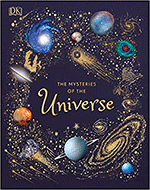
The Mysteries of the Universe Discover the best-kept secrets of space by Will Gater 224 pages, September 2020
Age Range: 7 to 9 years and up Each celestial body is shown both photographically and illustrated, and children will love poring over the detailed close-up images. Engaging storybook-style descriptions of each object allow readers to delve into myths, legends, trivia, and key discoveries about the solar system and beyond. Wonder at the rocky rings around Saturn, discover the tale behind the constellation Centaurus, and gaze at the fountains gushing from Jupiter's moon Enceladus. With reference pages packed with fascinating information, you'll go away knowing something you didn't before, and you'll return time and again. An attractive gift for children who can't get enough of astronomy, The Mysteries of the Universe is perfect for kids to explore by themselves or for bedtime stories.
About the Author:
Amazon.com Customer Comment: |
|
| ||

|
A Child's Introduction to Space Exploration An Explorer's Guide to Rockets, Astronauts, and Life in Zero Gravity by Michael E. Bakich, David J. Eicher and Chelen Ecija (illustrator) 96 pages, September 2022 Level: Kids Aged 8-12
List Price: We are living in a golden age of astronomy and space exploration, with more discoveries about the universe every day. With so many possibilities now open to us, revered science writers Michael E. Bakich and David J. Eicher will take young readers on a journey to the throughout the universe in this latest edition of A Child's Introduction series. Perfect for budding explorers aged 8-12, Bakich and Eicher explore the history of space exploration from the very first rocket in China, to the moon landing, to the latest missions to Mars (and beyond). They also include profiles of noteworthy scientists, engineers, and astronauts including Isaac Newton, Neil Armstrong, Mae Carol Jemison; fun sections on space food, UFOs, a timeline of space suits, and how to go to the bathroom in space; and STEM experiments like how to build your own rocket and how to tell time using the sun. Packed with dozens of NASA photos and charming original illustrations, and a pull-out poster, this fascinating book reveals the wonders of space exploration -- past, present and future!
|
|
| ||
|
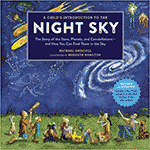
A Child's Introduction to the Night Sky The Story of the Stars, Planets, and Constellations--and How You Can Find Them in the Sky by Meredith Hamilton and David Driscoll 96 pages, Revised Edition, September 2019 Highly Recommended
Age Range: 8 to 12 years A Child's Introduction to the Night Sky is the perfect introduction to the always fascinating world of astronomy. Children ages eight and up will find out what astronomers have learned (and are still discovering), what astronauts and scientists explore, and what they can find by gazing up into the sky at night. Author Michael Driscoll explains how stars are born, the achievements of the great scientists, the history of space exploration, the story of our solar system, the myths behind the constellations, how to navigate the night sky, and more. Whimsical color illustrations throughout and handy definitions and sidebars help engage younger readers and develop their interest. Also included are a nifty star finder tool and fun glow-in-the-dark stickers.
Amazon.com Customer Comment: |
|
| ||
|
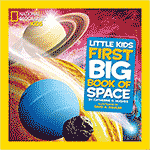
Little Kids First Big Book of Space by Catherine D. Hughes 128 pages, October 2012
Age Range: 4 to 8 years
Amazon.com Customer Comment: |
|
| ||
|
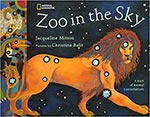
Zoo in the Sky A Book of Animal Constellations by Jacqueline Mitton, Christina Balit, and Wil Tirion 32 pages, October 2006
Age Range: 6 to 9 years
Amazon.com Customer Comment: |
|
| ||
|
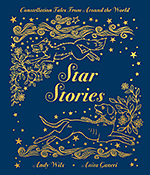
Star Stories Constellation Tales From Around the World by Anita Ganeri and Andy Wilx (illustrator) 96 pages, July 2019
Age Range: 8 to 11 years For thousands of years people have looked up to the night sky and told stories about the stars. These epic tales tell of vengeful gods and goddesses, of monsters and heroes. Others try to make sense of the natural world, or unravel the mysterious forces of the universe. This stunning book brings together 23 of these legends from all over the world: from Ancient Greece to North America, Egypt, China, India, and the South Pacific. Written by award-winning author Anita Ganeri and with beautifully detailed artwork by illustrator Andy Wilx, this is a magical book to be treasured for generations to come.
Reviewer's Comment: This beautiful book brings together legends from around the world that relate to constellations. There are stories about Heracles, Pegasus, Taurus, The Big Dipper and Orion. Each is just a few pages long but had enough information to be interesting to both adults and children. The illustrations are striking, in predominantly gold and warm colours, some of them covering whole pages, and some dotted around the text, so there is plenty to catch the eye.
more» |
|
| ||
|
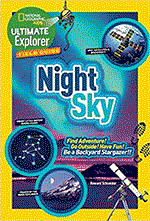
Ultimate Explorer Field Guide: Night Sky Find Adventure! Go Outside! Have Fun! Be a Backyard Stargazer! by Howard Schneider 160 pages, October 2016
Age Range: 8 to 12 years A National Geographic Kids Ultimate Explorer Field Guide.
Amazon.com Customer Comment: |
|
| ||
|
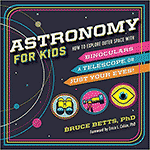
Astronomy for Kids How to Explore Outer Space with Binoculars, a Telescope, or Just Your Eyes! by Dr Bruce Betts 168 pages, November 2018 Highly Recommended
Age Range: 7 to 13 years One of the coolest things about outer space is that anyone can explore it. All you have to do is go outside and look up! Using plain sight, binoculars, or a small telescope, Astronomy for Kids shows stargazers how easy it is to explore space, just by stepping outside. With this book as their guide to the northern hemisphere, kids will learn to find and name amazing objects in the night sky. Fully illustrated with fun facts throughout, kids can point out sights to friends and family, saying things like, "that's Jupiter," and, "those stars are the constellation Cygnus the Swan," and maybe even, "that group of stars doesn't have a name but I think it looks like my dog getting belly rubs." From the Milky Way Galaxy to Mars to the Moon's craters and mountains -- Astronomy for Kids helps young astronomers discover important parts of our solar system, with:
Amazon.com Customer Comment: |
|
| ||
|
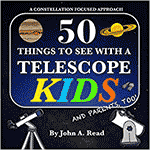
50 Things To See With A Telescope -- Kids and Parents, Too! A Constellation Focused Approach by John A Read 72 pages, July 2017
Age Range: 7 to 12 years
Amazon.com Customer Comment: |
|
| ||
|
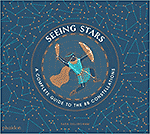
Seeing Stars A Complete Guide to the 88 Constellations by Sara Gillingham 216 pages, November 2018
Age Range: 8 to 11 years Complete with star maps and a glossary, this keepsake volume of visual reference and beauty is perfect for inquisitive young stargazers. Colors are brighter than they appear -- printed in pure Pantones. Book jacket features foil stamping and laser-cut pinholes.
Amazon.com Customer Comment: |
|
| ||
|
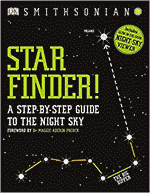
Star Finder! A Step-by-Step Guide to the Night Sky by DK Publishing 128 pages, October 2017
Age Range: 8 to 12 years Budding astronomers will love this stunning, new approach to stargazing, featuring step-by-step guides to identifying more than 20 constellations across the northern hemisphere, and making the night sky easier to navigate than ever before. From the constellations of the Zodiac to our very own Milky Way, kids can learn the learn the fascinating stories behind each constellation and learn to spot some of the stunning planets, galaxies, and nebulas in our universe. Four paths across the sky will lead readers from one constellation to the next, gradually building upon their knowledge. StarFinder! comes complete with a glow-in-the dark star finder, perfect for budding stargazers to practice their new knowledge under the night sky.
Amazon.com Customer Comment: |
|
| ||
|
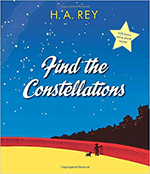
Find the Constellations A New Way to See Them by Hans Augusto Rey 72 pages, December 2016 Highly Recommended
Age Range: 10 to 12 years This updated version includes quizzes, timetables, a sky chart, and chapters on the solar system and space travel. The sections on the solar system, including information on dwarf planets, have been revised, and the planet finder chart includes locations through the year 2026. Plus, a new online planet locator to help find the exact positions of all the planets through 2100!
Amazon.com Customer Comment: |
|
| ||
|
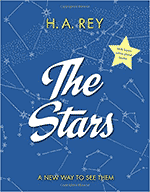
The Stars A New Way to See Them by Hans Augusto Rey 160 pages, December 2016
Age Range: 12 years and up This updated version includes revised facts and figures for planets, and new scientific information has been added. Charts indicate planet locations through the year 2026 and a website for finding locations well into the twenty-first century has been provided.
Amazon.com Customer Comment: |
|
| ||

|
What We See in the Stars An Illustrated Tour of the Night Sky by Kelsey Oseid 160 pages, 1st Edition, September 2017 Level: Beginner
List Price: Combining art, mythology, and science, What We See in the Stars gives readers a tour of the night sky through more than 100 magical pieces of original art, all accompanied by text that weaves related legends and lore with scientific facts. This beautifully packaged book covers the night sky's most brilliant features -- such as the constellations, the moon, the bright stars, and the visible planets -- as well as less familiar celestial phenomena like the outer planets, nebulae, and deep space. Adults seeking to recapture the magic of youthful stargazing, younger readers interested in learning about natural history and outer space, and those who appreciate beautiful, hand-painted art will all delight in this charming book.
Amazon.com Customer Comment: |
|
| ||

|
50 Things to See with a Telescope A Young Stargazer's Guide by John A. Read 72 pages, August 2018 Level: Beginner
List Price: About the Author: John A. Read volunteered at hundreds of stargazing events as a member of the Mount Diablo Astronomical Society in California, teaching people of all ages how to use a telescope and find objects in the sky. John is a telescope at the Burke-Gaffney Observatory and a board member at the Halifax Centre of the Royal Astronomical Society of Canada. He lives in Halifax, Nova Scotia.
Amazon.com Customer Comment: |
|
|


 (2004 Edition)
 From the product description it sounds like it was meant for younger readers, but it is perfect for nerds of any age who would like a practical guide to locating constellations.
|
Skymaps.com/store -- Recommended Books & Products for Skywatchers |
|
New Books •
Star Atlases •
Planispheres •
Getting Started •
Observing Guides •
Telescope Books •
Kids Books •
Sky Myths
Almanacs • History & Artistry • Star Map Prints • AstroPhotography • Telescopes & Binoculars • Media • Astro Calendars |
|
 |
HOW TO ORDER: Step 1: Click item's Buy from Amazon link (opens a new window). Step 2: Click the "Add to Shopping Cart" button. Do this before browsing. Step 3: Repeat Steps 1 & 2 to add more items to same shopping cart. Step 4: Click the "Proceed to Checkout" button to complete the purchase. |
Copyright - Terms of Use - Privacy Policy - Contact Us Copyright © 2000-2025 Kym Thalassoudis. All Rights Reserved. |
|
Helpful Pages for Amazon.com Customers Payment Methods • Shipping & Delivery • Guarantee Protection • Returns Policy |