 |
Home | Services | Store | Downloads | Articles | Help | |
|
Recommended Books & Products In association with our trusted partners Amazon and High Point Scientific |
||
|
Skymaps.com/store -- Recommended Books & Products for Skywatchers |
|
New Books •
Star Atlases •
Planispheres •
Getting Started •
Observing Guides •
Telescope Books •
Kids Books •
Sky Myths
Almanacs • History & Artistry • Star Map Prints • AstroPhotography • Telescopes & Binoculars • Media • Astro Calendars |
| As an Amazon & HPS affiliate we earn a small commission (at no extra cost to you) from qualifying purchases |
 |
|
Help Support The Evening Sky Map The Evening Sky Map is designed to help all sky watchers to discover the wonders of the night sky. Monthly editions for Northern, Southern and Equatorial latitudes make The Evening Sky Map a unique resource for users worldwide. Please consider supporting this free service by making a donation or by purchasing recommended products. Thank you. |
| ||
| Category >> | Observing Guides | |
| Compact field guides, deep-sky handbooks, and books featuring night sky tours for small telescopes. | ||
|

|
110 Things to See With a Telescope The World's Most Famous Stargazing List by John Read with Chris Vaughan 142 pages, August 2021
List Price: Finding the 110 Messier objects has never been easier! We provide a star map for each target plus written directions for how to find it by star-hopping, an "eyepiece view" image to confirm you're seeing it, observing tips from two veteran stargazers, and interesting facts. We also highlight additional nearby objects. These objects are presented in their recommended viewing order -- either by season, or during an all-night marathon! Each page contains an observation log so you can track your progress, and later apply for a Messier Observing Certificate from the Astronomical League and the Royal Astronomical Society of Canada. Certificate Application instructions are provided in the appendix of the book.
About the Authors: Chris Vaughan is an award-winning Astronomer and Earth Scientist with a lifelong passion for visual observing. He operates the David Dunlap Observatory's 74-inch telescope, volunteers for RASC, and visits schools with his Digital Starlab planetarium. His Astronomy Skylights blog at www.AstroGeo.ca is read worldwide, and he is a regular contributor to SkyNews magazine, Space.com, and popular astronomy apps. |
|
| ||

|
100 Things to See in the Night Sky, Expanded Edition Your Illustrated Guide to the Planets, Satellites, Constellations, and More by Dean Regas 256 pages, June 2020
List Price: Keep your feet on the ground and experience the night sky to the fullest by exploring planets, satellites, and constellations with this all-inclusive reference guide to space. 100 Things to See in the Night Sky, Expanded Edition is full of information on the many amazing things you can see with a telescope, or just your naked eye! From shooting stars to constellations and planets to satellites, this book gives you a clear picture of what you can see on any given night. Learn about the celestial bodies that have captured people's imaginations for centuries, with specific facts alongside traditional myths and beautifully illustrated photographs and star charts that will help you know where to look for the best view. With this illuminating guide, you'll enjoy hours of stargazing, whether you're travelling, camping, sitting in your back yard, or simply flipping through the beautiful images in this book.
About the Author: |
|
| ||

|
Exploring The Moon With Robert Reeves Observing and Understanding Our Natural Satellite by Robert Reeves 300 pages, 1st Edition, August 2023 Level: Intermediate to Advanced
List Price: In his new book Exploring the Moon with Robert Reeves, Robert helps the reader appreciate the Moon's beauty as well as the science of the Moon. Robert helps us see the Moon as both a mysterious world puzzled over in the past and a world full of promise for future exploration. Robert explains the nuances of the Moon and its varied geology to bring context to its face and give the Moon a personality, and making the Moon a valued nighttime friend. Features:
|
|
| ||

|
Star and Planets The Most Complete Guide to the Stars, Planets, Galaxies, and Solar System by Ian Ridpath and Wil Tirion 400 pages, October 2017 Level: All Highly Recommended
List Price: This updated edition features the latest information on stars, a revised section on planets that incorporates recent research on exoplanets, and some revised charts and new photographs. Simply put, Stars and Planets is indispensable. Don't leave home -- at night -- without it.
Amazon.com Customer Comment: |
|
| ||

|
National Geographic Backyard Guide to the Night Sky by Andrew Fazekas and Howard Schneider 288 pages, 2nd Edition, March 2019 Level: All
List Price: Stargazing's too much fun to leave to astronomers. In these inviting pages, "Night Sky Guy" Andrew Fazekas takes an expert but easygoing approach that will delight would-be astronomers of all levels. Essential information, organized logically, brings the solar system, stars, and planets to life in your own backyard. Start with the easiest constellations and then "star-hop" across the night sky to find others nearby. Learn about the dark side of the moon, how to pick Mars out of a planetary lineup, and which kinds of stars twinkle in your favorite constellations. Hands-on tips and techniques for observing with the naked eye, binoculars, or a telescope help make the most out of sightings and astronomical phenomena such as eclipses and meteor showers. Photographs and graphics present key facts in an easy-to-understand format, explaining heavenly phenomena such as black holes, solar flares, and supernovas. Revised to make skywatching even easier for the whole family, this indispensable guide shines light on the night sky--truly one of the greatest shows on Earth!
Amazon.com Customer Comment: |
|
| ||
|
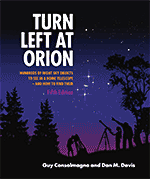
Turn Left at Orion Hundreds of Night Sky Objects to See in a Home Telescope and How to Find Them by Guy Consolmagno and Dan M. Davis 256 pages, 600 b/w illus., 20 tables, 5th Edition, January 2019 Level: Beginner to Intermediate Highly Recommended
List Price: Description: With over 150,000 copies sold since first publication, this is one of the most popular astronomy books of all time. It is a unique guidebook to the night sky, providing all the information you need to observe a whole host of celestial objects. With a new spiral binding, this edition is even easier to use outdoors at the telescope and is the ideal beginner's book. Keeping its distinct one-object-per-spread format, this edition is also designed for Dobsonian telescopes, as well as for smaller reflectors and refractors, and covers Southern hemisphere objects in more detail. Large-format eyepiece views, positioned side-by-side, show objects exactly as they are seen through a telescope, and with improved directions, updated tables of astronomical information and an expanded night-by-night Moon section, it has never been easier to explore the night sky on your own. New in the 5th Edition:
Amazon.com Customer Comment: |
|
| ||

|
Deep-Sky Wonders A Tour of the Universe by Sue French 320 pages, September 2011 Level: Intermediate to Advanced Highly Recommended
List Price: Deep-Sky Wonders is a welcome expansion of that winning format. A new collection of the best of French's "Deep-Sky Wonders" columns, the book is organized by season and subdivided into months, offering readers a total of 100 in-depth tours of the deep sky with enduring relevance.
The book includes: Suitable for beginning and intermediate small-scope astronomers as well as large-scope viewers and astrophotographers, this book will be greeted enthusiastically by all Sky and Telescope readers, especially French's many fans. It is also an outstanding introduction to deep-sky viewing for novice observers. About the Author: Sue French has been an avid deep-sky observer for 32 years and has worked as a planetarium educator for 18 years. She sets up her telescope in her backyard near Schenectady, New York, but travels regularly to enjoy the deep sky from different vantage points.
Amazon.com Customer Comment: |
|
| ||

|
Cosmic Challenge The Ultimate Observing List for Amateurs by Philip S. Harrington 478 pages, July 2019 Level: All
List Price: Each target object is accompanied by a rating indicating how difficult the object is to find, an in-depth visual description, an illustration showing how the object realistically looks, and a detailed finder chart to help you find each challenge quickly and effectively. This guide introduces objects often overlooked in other observing guides and challenges are provided for the naked eye, through binoculars, to the largest backyard telescopes. This latest edition has updated charts and data tables to challenge observers for many years to come. About the Author: A lifelong amateur astronomer, Phil Harrington was bitten by the "astronomical bug" when he was assigned to watch the total lunar eclipse of April 1968 as a homework assignment. Since then, Phil has spent countless hours touring the universe through telescopes and binoculars. He is a former staff member of New York City's Hayden Planetarium and instructor at the Vanderbilt Planetarium in Centerport, New York. Phil is an adjunct professor at Suffolk County Community College, Selden, New York, where he teaches courses in stellar and planetary astronomy. He is also a contributing editor for Astronomy magazine, where he frequently reviews telescopes, binoculars, and other astronomical equipment, as well as the magazine's monthly "Binocular Universe" column.
Amazon.com Customer Comment: |
|
| ||

|
An Anthology of Visual Double Stars by Bob Argyle, Andrew James and Mike Swan (illustrator) 486 pages, 1st Edition, October 2019 Level: All
List Price: Wide-field finder charts are presented for each system along with plots of the apparent orbits and predicted future positions for the orbital systems. Recent measurements of each system are included which will help you to decide whether they can be seen in your telescope, as well as giving advice on the aperture needed. Double star observers of all levels of experience will treasure the level of detail in this guide to these jewels of the night sky.
Bob Argyle has observed double stars since 1966. He has been Director of the Webb Deep-Sky Society's Double Star Section since 1970. He edited Observing and Measuring Visual Double Stars (2012) and writes monthly columns on double stars for Astronomy Now and the Webb Society. He is a Fellow of Royal Astronomical Society, a Member of the International Astronomical Union and Editor of Observatory magazine. Andrew James has been interested in double stars since the late 1970s. He is a long-term member, and past President, of the Astronomical Society of New South Wales (ASNSW), and formed its Double Star Section in 1979. His interests include the historical backgrounds and works of various discoverers of southern double stars. Mike Swan worked for the Ordnance Survey in England. He has extensive experience in computer graphics and uranography and was solely responsible for the Webb Deep-Sky Society Star Atlas. He is currently completing a two part Atlas of Galactic Clusters. In this volume he produced the finder charts, the all-sky charts and orbital plots. |
|
| ||

|
The Monthly Sky Guide by Ian Ridpath and Wil Tirion (illustrator) 80 pages, 10th Edition, July 2019 Level: All
List Price: Most of the sights are visible to the naked eye, and all can be seen with binoculars or a small telescope. Sections on observing the moon and the planets include 50 easy-to-use maps that introduce the skies of the Northern Hemisphere and a comprehensive guide to observing the Moon.
Amazon.com Customer Comment: |
|
| ||

|
100 Things to See in the Night Sky From Planets and Satellites to Meteors and Constellations, Your Guide to Stargazing by Dean Regas 224 pages, November 2017 Level: Beginner
List Price: The night sky is full of amazing things to see -- from shooting stars and constellations to planets and satellites -- but it can be hard to tell what you're seeing, or where to look for the best view. 100 Things to See in the Night Sky gives you a clear picture of what you can see on any given night, either using a small telescope, or just your naked eye. Each object is presented as a separate entry, with background information on the makeup, appearance, and history of the object, along with easy-to-follow instructions on how to find it. For astronomy and space fans of all ages, this guide helps you explore the galaxy and see the star -- while keeping your feet on the ground. About the Author: Dean Regas has been the astronomer for the Cincinnati Observatory since 2000 and the cohost of the syndicated astronomy program Star Gazers since 2010. He is a contributing editor to Sky and Telescope magazine and a contributor to Astronomy magazine, where he won the 2008 "Out-of-this-World" Award for astronomy education. Dean has been a frequent guest on National Public Radio's Science Friday with Ira Flatow, and this year he began an astronomy podcast with Anna Hehman called "Looking Up!"
Amazon.com Customer Comment: |
|
| ||

|
100 Things to See in the Southern Night Sky From Planets and Satellites to Meteors and Constellations, Your Guide to Stargazing by Dean Regas 224 pages, June 2018 Level: Beginner
List Price: The night sky is full of amazing things to see, from shooting stars and constellations, to planets and satellites, but it can be hard to tell what you're seeing, or where to look for the best view. 100 Things to See in the Southern Night Sky lets you know what you can expect to see on any given night, whether you're using a small telescope, or just your naked eye. 100 Things to See in the Southern Night Sky -- especially for those south of the equator -- includes background information on the makeup, appearance, and history of each celestial object, along with easy-to-follow instructions on the best way to catch a glimpse of these cosmic glories. With this helpful guide you'll have the world on a string -- or more precisely, the sky in your hands. About the Author: Dean Regas has been the astronomer for the Cincinnati Observatory since 2000 and the cohost of the syndicated astronomy program Star Gazers since 2010. He is a contributing editor to Sky and Telescope magazine and a contributor to Astronomy magazine, where he won the 2008 "Out-of-this-World" Award for astronomy education. Dean has been a frequent guest on National Public Radio's Science Friday with Ira Flatow, and this year he began an astronomy podcast with Anna Hehman called "Looking Up!"
|
|
| ||

|
50 Things To See With A Small Telescope by John A. Read 74 pages, 1st Edition, May 2013. Revised in 2016. Level: Beginner
List Price:
Description: People love this book! Revised in 2016, 50 Things to See with a Small Telescope highlights the must-see objects observed at stargazing events all over the Northern Hemisphere. (Now also available in a Southern Hemisphere Edition.) People of all ages frequently ask, "How did you find that so quickly?" Well, this book will explain just that! The planets in our solar system, the International Space Station, sunspots, birds, nebula, airplanes, and comets are just some of the items that his book will help you find! If you have been having difficulties enjoying your small telescope, this book is for you. There is something interesting about pretty much everything in outer space and it is exciting how many pop-culture references are derived from things in the night sky! Viewing the stars referenced in Star Trek, or talking about a character in Harry Potter named after a constellation, is just another way to make stargazing that much more fun! I am very excited to share my knowledge of astronomy and I am sure you will enjoy this book for years to come. By working through the 50 items in this book you will achieve a well-rounded understanding of amateur astronomy.
Amazon.com Customer Comment: |
|
| ||

|
50 Targets for the Mid-Sized Telescope by John A. Read 68 pages, March 2017 Level: Beginner
List Price: Each target has been carefully chosen to be observable in telescopes with apertures between four and eight inches. Most objects can be viewed from the suburbs in mildly light polluted conditions, with only a few noted exceptions requiring darker skies. On dark, moonless nights, most targets will be visible in small telescopes and binoculars too.
Amazon.com Customer Comment: |
|
|



|
Skymaps.com/store -- Recommended Books & Products for Skywatchers |
|
New Books •
Star Atlases •
Planispheres •
Getting Started •
Observing Guides •
Telescope Books •
Kids Books •
Sky Myths
Almanacs • History & Artistry • Star Map Prints • AstroPhotography • Telescopes & Binoculars • Media • Astro Calendars |
|
 |
HOW TO ORDER: Step 1: Click item's Buy from Amazon link (opens a new window). Step 2: Click the "Add to Shopping Cart" button. Do this before browsing. Step 3: Repeat Steps 1 & 2 to add more items to same shopping cart. Step 4: Click the "Proceed to Checkout" button to complete the purchase. |
Copyright - Terms of Use - Privacy Policy - Contact Us Copyright © 2000-2023 Kym Thalassoudis. All Rights Reserved. |
|
Helpful Pages for Amazon.com Customers Payment Methods • Shipping & Delivery • Guarantee Protection • Returns Policy |