 |
Home | Services | Store | Downloads | Articles | Help | |
|
Recommended Books & Products In association with our trusted partner, Amazon.com. |
||
|
Skymaps.com/store -- Recommended Books & Products for Skywatchers |
|
New Books •
Star Atlases •
Planispheres •
Getting Started •
Observing Guides •
Telescope Books •
Kids Books •
Sky Myths
Almanacs • History & Artistry • Star Map Prints • AstroPhotography • Telescopes & Binoculars • Media • Astro Calendars |
| As an Amazon & HPS affiliate we earn a small commission (at no extra cost to you) from qualifying purchases |
 |
|
Help Support The Evening Sky Map The Evening Sky Map is designed to help all sky watchers to discover the wonders of the night sky. Monthly editions for Northern, Southern and Equatorial latitudes make The Evening Sky Map a unique resource for users worldwide. Please consider supporting this free service by making a donation or by purchasing recommended products. Thank you. |
| ||
| Category >> | New Books & Products | |
| New Astronomy books are released throughout the year. We thumb through the catalogs to find the best new and upcoming titles for skywatchers. | ||
|

|
Islands in Infinity Galaxies in 3-D by Prof. Derek Ward-Thompson (author), Sir Brian May (author) and J.-P. Metsävainio (photographer) 224 pages, November 2025
List Price: We're taken on a journey, travelling through weird and wonderful shapes as great galaxies collide and merge in chaotic and extraordinarily forms. And, moving out towards the edge of the visible Universe, we examine how galaxies gather in clusters and superclusters as we look outwards and back in time towards the beginning of the Universe at the Big Bang. Highlights include:
Co-published with London Stereoscopic Company. The University of Arizona Press is pleased to offer this title in North America.
About the Authors: Sir Brian May CBE, PhD, ARCS, FRAS is a founding member of the rock group Queen, a world-renowned guitarist, songwriter, producer, performer, 3-D photographic authority, author, publisher, and passionate campaigner for animal rights. A graduate of Imperial College London, Brian started a PhD in Astrophysics but in 1974 music took over, and it was not until 2006 that he was able to complete his studies at Imperial and was awarded his PhD in 2007. Since then he has co-written five astronomy books, and has worked with NASA, ESA and JAXA providing 3-D imaging for numerous current space missions. J-P Metsävainio is a Finnish visual artist and impassioned astronomical photographer who uses scientific and computational tools and methods to reveal the nocturnal world of wonders. To satisfy his endless curiosity, he developed a method to turn any cosmic photograph into a realistic 3-D image. In his work, Art meets Science in a most beautiful way. He created the 3-D astronomical images for a previous collaboration with Sir Brian and David J. Eicher: Cosmic Clouds 3-D (2020).
|
|
| ||
|
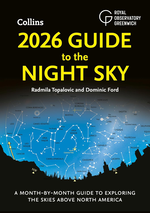
2026 Guide to the Night Sky A month-by-month guide to exploring the skies above North America by Radmila Topalovic and Dominic Ford 112 pages, December 2025 Level: All
List Price: Available as a Southern Hemisphere Edition at: Description: This is the ideal resource for beginners and experienced stargazers in the United States and Canada, and has been updated to include new and practical information covering events occurring in North America's night sky throughout 2026. This practical guide is both an easy introduction to astronomy and a useful reference for seasoned stargazers. Now includes a section on comets and a map of the moon. Designed specifically for North America. Written and illustrated by astronomical experts. Written and illustrated by astronomical experts, Storm Dunlop and Wil Tirion, and approved by the astronomers of the Royal Observatory Greenwich. Content includes:
 I needed to find a quick guide to the night sky that was above beginners' level and was also a ready reference for my observing gear. This is IT!!
more» I needed to find a quick guide to the night sky that was above beginners' level and was also a ready reference for my observing gear. This is IT!!
more» |
|
| ||
|
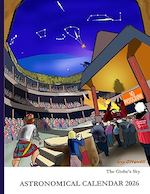
Astronomical Calendar 2026 by Guy Ottewell 141 pages, November 2025 Level: All
List Price: The 2026 book is like the former ones but in more compact size (8.5 by 11 inches), so that there are more pages. The content is as vast as before: monthly spreads with listings of events (nearly 600 altogether) and sky dome and solar-sytem view; many sky scenes; sections on the Sun and seasons, the Moon, eclipses, occultations, each planet, asteroids, meteor showers; full explanation, and a glossary of terms. Unlike the former books, the 2026 book has full color. Yet it is cheaper!
Reviewer: "The large Ottewell calendar deserves pride of place... a work of kinematics-made-vivid... a piece of original samizdat... Its author is a gifted artist... To his talented brush, his sense of form in space, and his apt and pithy choice of words, he has added a deft hand at the computer keyboard." -- Philip Morrison in Scientific American
more» |
|
| ||
|
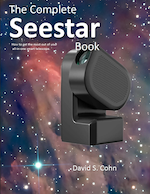
The Complete Seestar Book How to get the most out of your all-in-one smart telescope by David S. Cohn 172 pages, October 2025
List Price:
But what if the Seestar actually came with a manual?
One of the foremost trainers in the world is about to provide you with just that... a complete reference to the Seestar from ZWO.
You will learn how to get the most out of your telescope, using techniques that will get you over any hurdle and up to speed in no time.
David leaves all the techno-speak behind and, instead, treats the whole book as if it were just you and him out in the yard shooting images with the Seestar. By breaking each topic down into simple, easy-to-follow, illustrated steps, you will learn:
|
|
| ||

|
Night Sky Guide 2026 North America's Skies Month-by-Month from The Royal Astronomical Society of Canada by Nicole Mortillaro 128 pages, September 2025
List Price: Night Sky Guide 2026 is the ideal resource for both novice and experienced sky watchers in the United States and Canada, with all the advice, information and data that enthusiasts need to understand and enjoy the wonders of the night sky. This in-depth guide introduces readers to the objects in the sky -- from stars, to comets, to globular clusters -- and then takes them through the cosmic events to look out for each month in 2026, with sky maps, moon phase charts and info about the planets. The book also features:
The Royal Astronomical Society of Canada (RASC) was founded ad hoc in 1868 and incorporated in 1890 with a dual membership of professionals and amateurs. It has 29 Canadian chapters and over 5,000 members. The Journal of The Royal Astronomical Society of Canada is entering its 118th year of publication, and the RASC also produces a number of other publications and guidebooks.
About the Author: |
|
| ||

|
Star Gazers Finding Joy in the Night Sky by David H. Levy 172 pages, March 2025
List Price: Bringing together writing from across two decades of stargazing, Levy explores the different aspects of the night sky, from the simple star-studded vault that appears every clear night, to insight into how some amateur astronomers use advanced equipment to image details of the night sky. He writes about the James Webb Space Telescope and the Northern Lights, offering commentary on astronomical events and the profound questions they inspire. While there are books that describe how to observe the sky, this book explains why. Star Gazers is a celebration of the joy and mystery found in the stars, with the author’s personal experiences serving as a continuous thread throughout. Whether you are a seasoned astronomer or a curious newcomer, Star Gazers will inspire you to look up and embrace the night sky with renewed passion and curiosity.
About the Author: |
|
| ||

|
2025 Guide to the Night Sky A month-by-month guide to exploring the skies above North America by Storm Dunlop and Wil Tirion 112 pages, November 2024 Level: All
List Price: Available as a Southern Hemisphere Edition at: Description: This is the ideal gift for beginners and experienced stargazers in the United States and Canada and has been updated to include new and practical information covering events occurring in North America's night sky throughout 2025. This practical guide is both an easy introduction to astronomy and a useful reference for seasoned stargazers. Now includes a section on comets and a map of the moon. Written and illustrated by astronomical experts, Storm Dunlop and Wil Tirion, and approved by the astronomers of the Royal Observatory Greenwich. Content includes:
Great little book for backyard stargazers like me. Details moon phases, planets, and deep sky objects by month for north and south facing views.
more» |
|
| ||

|
2025 Night Sky Almanac A Month-by-Month Guide to North America's Skies from the Royal Astronomical Society of Canada by Nicole Mortillaro 128 pages, August 2024
List Price: The 2025 Night Sky Almanac is the ideal resource for both novice and experienced sky watchers in the United States and Canada, with all of the advice, information and data that enthusiasts need to understand and enjoy the wonders of the night sky. This in-depth guide first introduces readers to the objects in the sky -- from stars, to comets, to globular clusters -- and then takes them through the cosmic events to look out for each month in 2025, with sky maps, moon phase charts and info about the planets. The book also features:
2025 Night Sky Almanac is both a comprehensive introduction to Astronomy and a quick reference book for more experienced sky watchers who don't want to miss a thing. Its compact size means it's perfect for taking on an "astro-vacation" or simply sky viewing in the backyard. The Royal Astronomical Society of Canada (RASC) was founded ad hoc in 1868 and incorporated in 1890 with a dual membership of professionals and amateurs. It has 29 Canadian chapters and over 5,000 members. The Journal of the Royal Astronomical Society of Canada is entering its 117th year of publication, and the RASC also produces a number of other publications and guidebooks.
About the Author: |
|
| ||

|
Nightwatch -- New 5th Edition (2023) A Practical Guide to Viewing the Universe by Terence Dickinson (Author), Ken Hewitt-White (Author), Richard Tresch Fienberg (Foreword) 208 pages, 5th Edition, September 2023. Revised 5th Edition updated for use through 2035. Level: Beginner to Intermediate Highly Recommended List Price: Amazon Price: Click Here & Save Average customer rating: More info (Concealed Wiro-Bound Hardcover): click here  Also available at: Amazon.co.uk (UK) Stargazing enthusiasts of all levels of experience will discover much of value in an enduring reference conceived by one of the most respected names in amateur astronomy. This must-have Fifth Edition includes:
Much has happened in this popular hobby since the revised Fourth Edition of NightWatch was published in 2006. In response, the text has been substantially revised and updated throughout all 13 chapters. Moreover, the book has been completely redesigned and most of its many photographs have been replaced. A noted feature is the variety of superb astrophotos of star clusters, nebulas, galaxies and other celestial phenomena taken by accomplished amateur astronomers. Lavishly illustrated sections on the Moon and planets will inspire novice observers of the solar system. To accommodate the extensive revisions, NightWatch has grown from 192 pages to 208 pages. With the release of the Fifth Edition, we are also launching a new website, NightWatchBook.com, that will offer links to additional resources and will be regularly updated with information on new celestial events and equipment. Since the First Edition of NightWatch was released in 1983, the most significant transformations in amateur astronomy have been in optics and technology. For all the latest on gadgets and gear, renowned astrophotographer Alan Dyer, Dickinson's coauthor of The Backyard Astronomer's Guide, has contributed an entirely new chapter on basic digital astrophotography. Dyer has also modernized a key portion of an enlarged chapter on stargazing equipment, creating a welcoming place in NightWatch for today's computerized telescopes.
Amazon.com Customer Comment (previous edition): |
|
| ||

|
Night Sky Almanac A Stargazer's Guide to 2025 by Royal Observatory Greenwich, Storm Dunlop and Wil Tirion 272 pages, December 2024 Level: All
List Price: With the aid of easy-to-understand monthly calendars and maps, you will chart the rhythm of the lunar phases, discover events that light up the sky for brief periods, and explore the rich tapestry of characters that adorn the starry canvas overhead. Never miss a night sky event wherever you are in the world with this month-by-month guide go meteor spotting, track the phases of the moon and explore the constellations worldwide coverage. With details for both the Northern and Southern hemispheres discover fascinating celestial facts and notable astronomical anniversaries. Written and illustrated by astronomical experts Storm Dunlop and Wil Tirion, and approved by the astronomers of Royal Observatory Greenwich.
About the Authors: |
|
| ||

|
Exploring The Moon With Robert Reeves Observing and Understanding Our Natural Satellite by Robert Reeves 300 pages, 1st Edition, August 2023 Level: Intermediate to Advanced
List Price: In his new book Exploring the Moon with Robert Reeves, Robert helps the reader appreciate the Moon's beauty as well as the science of the Moon. Robert helps us see the Moon as both a mysterious world puzzled over in the past and a world full of promise for future exploration. Robert explains the nuances of the Moon and its varied geology to bring context to its face and give the Moon a personality, and making the Moon a valued nighttime friend. Features:
|
|
| ||
|
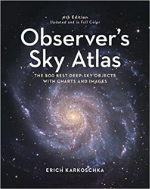
Observer's Sky Atlas The 500 Best Deep-Sky Objects With Charts and Images by Erich Karkoschka 144 pages, 4th Edition (Updated and in Full Color), March 2023 Level: All
List Price: This tremendous new edition of a classic book (previously published only in black-and-white) contains star charts and pictures, for all those who observe the night sky with unaided eyes, binoculars or telescopes. It is equally useful for beginners and experienced old hands at astronomy. A legend among hobby astronomers, this entirely revised and updated edition has new celestial maps in full color, up-to-date data from the Gaia spacecraft and unique comparison images of most visible celestial objects. Sixty-one all-new star charts are good through 2060, and there are 532 pictures of stars, galaxies and nebulae, 415 of them in full color. Very detailed position figures help the astronomer navigate the charts and accurately pinpoint objects for viewing -- and knowing what you're seeing. The hobby astronomer can use it to find star clusters, gaseous nebulae and galaxies throughout the night sky. Quick orientation is guaranteed, and intermediate astronomers can really enjoy the night sky for hours and hours by knowing where to locate the objects of their interest.
Amazon.com Customer Comment (3rd Edition): |
|
| ||
|
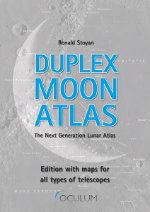
Duplex Moon Atlas The Next Generation Lunar Atlas by Ronald Stoyan 80 pages, 1st Edition, November 2022 Level: Intermediate to Advanced
List Price:
The Duplex Moon Atlas is designed to be used at the eyepiece. The colours are optimised for usage with a red torch at night. Atlas pages are printed to the margin and with the wire-o binding, pages can be spread out easily. Printed on laminated paper, dew wipes off easily, and the atlas will last a long time.
Amazon.com Customer Comment: |
|
| ||

|
National Geographic Stargazer's Atlas The Ultimate Guide to the Night Sky by Andrew Fazekas and National Geographic 432 pages, October 2022 Level: All
List Price: Combining science, exploration, and storytelling, National Geographic Stargazer's Atlas invites readers to roam the night sky for constellations, planets and moons, eclipses, comets and meteor showers, auroras, and deep-sky treasures including nebulae and galaxies?many visible to the naked eye and all with binoculars or a backyard telescope. Beginning with basic space science and including a complete set of night sky maps for all four seasons in the Northern and Southern Hemispheres, this fascinating book guides the reader toward the most rewarding observations. A unique chapter on astrotourism highlights ancient observatories, dark-sky preserves, and other global destinations for the sky-seeking traveler; a final chapter details current and future space missions and what they might discover. Richly illustrated with awe-inspiring imagery including photos from space missions and telescopes, science-based artists' interpretations, and explanatory graphics the book also contains 170 maps and charts of planets, moons, and constellations, from Earth's moon to moons of Saturn. Practical advice throughout helps readers see what they have been reading about, building key observational skills such as "star hopping" from easy-to-find stars to fainter deep-sky objects and focusing on "deep sky treasures" areas rich in observable phenomena. Approachable and authoritative, gorgeous and fascinating, National Geographic Stargazer's Atlas will intrigue all who love to gaze up in wonder at the night sky and find themselves wanting to know more.
Amazon.com Customer Comment: |
|
| ||

|
A Child's Introduction to Space Exploration An Explorer's Guide to Rockets, Astronauts, and Life in Zero Gravity by Michael E. Bakich, David J. Eicher and Chelen Ecija (illustrator) 96 pages, September 2022 Level: Kids Aged 8-12
List Price: We are living in a golden age of astronomy and space exploration, with more discoveries about the universe every day. With so many possibilities now open to us, revered science writers Michael E. Bakich and David J. Eicher will take young readers on a journey to the throughout the universe in this latest edition of A Child's Introduction series. Perfect for budding explorers aged 8-12, Bakich and Eicher explore the history of space exploration from the very first rocket in China, to the moon landing, to the latest missions to Mars (and beyond). They also include profiles of noteworthy scientists, engineers, and astronauts including Isaac Newton, Neil Armstrong, Mae Carol Jemison; fun sections on space food, UFOs, a timeline of space suits, and how to go to the bathroom in space; and STEM experiments like how to build your own rocket and how to tell time using the sun. Packed with dozens of NASA photos and charming original illustrations, and a pull-out poster, this fascinating book reveals the wonders of space exploration -- past, present and future!
|
|
| ||

|
The Deep-Sky Imaging Primer by Charles Bracken 280 pages, 3rd Edition, May 2022 Level: Intermediate to Advanced
List Price: Start-to-finish examples of image processing are included, with a focus on PixInsight. The book is 280 pages with 373 illustrations, printed in full-color.
|
|
| ||

|
The Secret World of Stargazing Find solace in the stars by Adrian West 224 pages, April 2022 Level: Beginner
List Price:
About the Author: Adrian has written many astronomy and space related articles for various online science magazines. Adrian runs Sky Tours for the National Trust and has also written guides and articles for the BBC, Met office and National Trust. The Night Sky show is Adrian's sell out theatre show that takes the audience on an epic journey across the cosmos.
Amazon.com Customer Comment: |
|
| ||
|
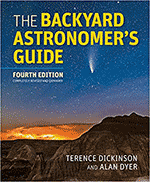
The Backyard Astronomer's Guide by Terence Dickinson (author), Alan Dyer (author), and Sara Seager (foreword) 416 pages, 4th Edition, September 2021 Level: Beginner to Intermediate Highly Recommended
List Price:
More info (Hardcover): click here Technology and astronomical understanding are evolving at a breathtaking clip, and to reflect the latest information about observing techniques and equipment, this massively revised and expanded edition has been completely rebuilt (an additional 48 pages brings the page count to 416). Illustrated throughout with all-new photographs and star charts, this edition boasts a refreshed design and features five brand-new chapters, including three essential essays on binocular, telescope and Moon tours by renowned astronomy writer Ken Hewitt-White. With new content on naked-eye sky sights, LED lighting technology, WiFi-enabled telescopes and the latest advances in binoculars, telescopes and other astronomical gear, the fourth edition of The Backyard Astronomer's Guide is sure to become an indispensable reference for all levels of stargazers. New techniques for observing the Sun, the Moon and solar and lunar eclipses are an especially timely addition, given the upcoming solar eclipses in 2023 and 2024. Rounding out these impressive offerings are new sections on dark sky reserves, astro-tourism, modern astrophotography and cellphone astrophotography, making this book an enduring must-have guide for anyone looking to improve his or her astronomical viewing experience. The Backyard Astronomer's Guide also features a foreword by Dr. Sara Seager, a Canadian-American astrophysicist and planetary scientist at the Massachusetts Institute of Technology and an internationally recognized expert in the search for exoplanets.
Amazon.com Customer Comment: |
|
| ||

|
Astronomy Activity Book for Kids 100+ Fun Ways to Learn About Space and Stargazing by Aurora Lipper (author) and Victoria Stebleva (illustrator) 160 pages, September 2021 Level: Ages 5 to 7
List Price: Space is awesome, and we can explore a lot of it from right here on Earth using our eyes, binoculars, and telescopes. In this interactive activity book, kids ages 5 to 7 get to be astronomers! Former NASA scientist Aurora Lipper leads an exciting journey through space, beginning with a tour of the planets and moons in our solar system. Next, kids visit the constellations and then zoom through the far reaches of the Milky Way galaxy. Along the way, they'll find amazing facts about the starry skies and get to color and draw, connect dots, find hidden objects, and have fun with word puzzles while improving math and reading skills. Astronomy Activity Book for Kids features:
Former NASA scientist Aurora Lipper is an astronomer, pilot, and busy mom of four. She runs Supercharged Science and teaches thousands of elementary school kids worldwide through her online classes and in-person science workshops. She is also president of the Central Coast Astronomical Society in California and a member of the Society of Women Engineers.
Amazon.com Customer Comment: |
|
| ||

|
110 Things to See With a Telescope The World's Most Famous Stargazing List by John Read with Chris Vaughan 142 pages, August 2021
List Price: Finding the 110 Messier objects has never been easier! We provide a star map for each target plus written directions for how to find it by star-hopping, an "eyepiece view" image to confirm you're seeing it, observing tips from two veteran stargazers, and interesting facts. We also highlight additional nearby objects. These objects are presented in their recommended viewing order -- either by season, or during an all-night marathon! Each page contains an observation log so you can track your progress, and later apply for a Messier Observing Certificate from the Astronomical League and the Royal Astronomical Society of Canada. Certificate Application instructions are provided in the appendix of the book.
About the Authors: Chris Vaughan is an award-winning Astronomer and Earth Scientist with a lifelong passion for visual observing. He operates the David Dunlap Observatory's 74-inch telescope, volunteers for RASC, and visits schools with his Digital Starlab planetarium. His Astronomy Skylights blog at www.AstroGeo.ca is read worldwide, and he is a regular contributor to SkyNews magazine, Space.com, and popular astronomy apps. |
|
| ||

|
Tales of the Night Sky Revealing the Mythologies and Folklore Behind the Constellations by Robin Kerod 128 pages, September 2020 Level: All
List Price: Astronomer and ordained ex-zen monk offers a modern approach to stargazing that reflects growing interest in popular and accessible science through mindfulness. Through a mix of both scientific fact and meditative insight, discover how the mysteries of the twinkly skies can connect us all more deeply to our inner selves. Noticing the bright constellations in the night skies above can foster a sense of curiosity, awe, and deep interconnection like nothing else on Earth. For each of the constellations, discover:
|
|
| ||

|
The Practical Astronomer Explore the Wonders of the Night Sky by Will Gater 264 pages, 3rd Edition, November 2020
List Price: his practical guide explains and demystifies stargazing, teaching you to recognize different kinds of objects and showing you how they move through the sky over the course of the night and the year. It shows you how to understand and enjoy the cosmos, building your practical astronomy skills from the basics to more advanced techniques. Beginning with an explanation of the Universe itself--how big is it, what shape is it, how old is it, and will it end?--it then takes you on a tour around the night sky, building up your knowledge in simple stages. Practical advice begins with naked-eye observations, then illustrated step-by-step instructions show you how to set up and use binoculars and telescopes and how to take your own pictures of the night sky. It also lets you take a closer look at the different objects you can view in the night sky, telling you how to train your eye to recognize basic patterns of stars (constellations) and how to tell planets apart from other celestial bodies, showing you how to observe them in an innovative step-by-step way. An atlas of the night sky is also included, with charts that can be used in both the northern and southern hemispheres throughout the year. Accessible, inspirational, and authoritative, The Practical Astronomer will enthuse and inform anyone who wants to expand their knowledge of the night sky.
About the Authors: |
|
| ||
|
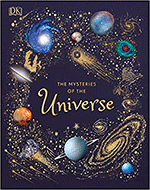
The Mysteries of the Universe Discover the best-kept secrets of space by Will Gater 224 pages, September 2020
List Price: Each celestial body is shown both photographically and illustrated, and children will love poring over the detailed close-up images. Engaging storybook-style descriptions of each object allow readers to delve into myths, legends, trivia, and key discoveries about the solar system and beyond. Wonder at the rocky rings around Saturn, discover the tale behind the constellation Centaurus, and gaze at the fountains gushing from Jupiter's moon Enceladus. With reference pages packed with fascinating information, you'll go away knowing something you didn't before, and you'll return time and again. An attractive gift for children who can't get enough of astronomy, The Mysteries of the Universe is perfect for kids to explore by themselves or for bedtime stories.
About the Author:
Amazon.com Customer Comment: |
|
| ||
|
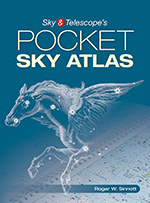
Pocket Sky Atlas -- New Edition due in August 2020 by Roger W. Sinnott 136 pages, 2nd Edition, August 2020 Level: Intermediate Size: 9.2 x 6.8 inches
List Price: Sky & Telescope's celestial atlases are the standard by which all other star atlases have been judged for more than half a century. Our Pocket Sky Atlas is no exception. This wonderfully detailed atlas is particularly handy to take on trips and use at the telescope, thanks to its compact size, convenient wire-bound design, and easy-to-read labels. To help you find your way, the charts show both constellation boundaries and stick figures. By popular request, two special new lists are included in this second edition. One is a table of the atlas's 53 stars of unusual reddish hue (also known as carbon stars), and the charts where they are found. The other is a list of 24 nearby stars, with their distances in light-years and the charts showing their locations. All can easily be spotted in small telescopes. Features:
Amazon.com Customer Comment: |
|
| ||
|
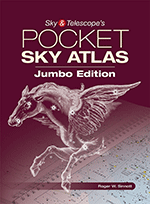
Pocket Sky Atlas: Jumbo Edition -- New Edition due in August 2020 by Roger W. Sinnott 136 pages, 2nd Edition, August 2020 Level: Intermediate Size: 11.9 x 9 inches
List Price: Sky & Telescope's celestial atlases are the standard by which all other star atlases have been judged for more than half a century. Our Pocket Sky Atlas -- Jumbo Edition is one of our favorites. This wonderfully detailed atlas is particularly handy to take on trips and use at the telescope, thanks to its larger size, convenient wire-bound design, and easy-to-read labels. To help you find your way, the charts show both constellation boundaries and stick figures. By popular request, two special new lists are included in this second edition. One is a table of the atlas's 53 stars of unusual reddish hue (also known as carbon stars), and the charts where they are found. The other is a list of 24 nearby stars, with their distances in light-years and the charts showing their locations. All can easily be spotted in small telescopes. Features:
|
|
| ||

|
100 Things to See in the Night Sky, Expanded Edition Your Illustrated Guide to the Planets, Satellites, Constellations, and More by Dean Regas 256 pages, June 2020
List Price: Keep your feet on the ground and experience the night sky to the fullest by exploring planets, satellites, and constellations with this all-inclusive reference guide to space. 100 Things to See in the Night Sky, Expanded Edition is full of information on the many amazing things you can see with a telescope, or just your naked eye! From shooting stars to constellations and planets to satellites, this book gives you a clear picture of what you can see on any given night. Learn about the celestial bodies that have captured people's imaginations for centuries, with specific facts alongside traditional myths and beautifully illustrated photographs and star charts that will help you know where to look for the best view. With this illuminating guide, you'll enjoy hours of stargazing, whether you're travelling, camping, sitting in your back yard, or simply flipping through the beautiful images in this book.
About the Author: |
|
| ||

|
Galaxies Inside the Universe's Star Cities by David J. Eicher 256 pages, May 2020
List Price: "The natural history of the galaxies is majestic and deserves its own David Attenborough. In David Eicher, it may have just found him." -- Richard Dawkins Journey to the edges of our galaxy and beyond with one of the most widely recognized astronomy experts as your guide. Delve into the history of stargazing and space observation, learn how black holes power galaxies, and understand the classification of the different galaxy types. This illuminating book -- with artful illustrations and never-before-seen space photography -- will open your mind to the wonders of the universe that await.
About the Author: |
|
| ||

|
Luna Cognita A Comprehensive Observer's Handbook of the Known Moon by Robert A. Garfinkle 1680 pages, February 2020
List Price: Volume 1 begins with a section on the Moon's place in human history, mythology and lore, before gravitating closer to the Moon itself through scientific sections on the Earth-Moon system, lunar motions and cycles. Following these are technical chapters on how to purchase, use and care for lunar observing and photography equipment. Techniques for observing the Moon (both with the naked eye and optical instruments) are detailed as the reader approaches the Moon's surface on this visual tour-de-force. A close-up exploration of the Moon is the result. The "crater-hop" chapters in Volumes 1 and 2 discuss the physical aspects of the Moon's features, offering brief biographical information on the person for whom the feature is named, as well as how each individual was involved in the development of science and selenography from ancient to modern times. Volume 3 contains a plethora of useful appendices that cover a range of topics, from catalogues of lunar features such as nearside lunar domes to a comprehensive list of publishers and observing organizations. Luna Cognita goes far beyond any recent work in both breadth and depth of coverage on the Moon. Written in an accessible, engaging manner for readers of all backgrounds and levels of expertise, this handbook is thus an invaluable resource for anybody who looks up at the glowing sphere in the night sky and wants to learn more about the "Known Moon."
Amazon.com Customer Comment: |
|
|

 Visually rich information and advice for stargazers.


|
Skymaps.com/store -- Recommended Books & Products for Skywatchers |
|
New Books •
Star Atlases •
Planispheres •
Getting Started •
Observing Guides •
Telescope Books •
Kids Books •
Sky Myths
Almanacs • History & Artistry • Star Map Prints • AstroPhotography • Telescopes & Binoculars • Media • Astro Calendars |
|
 |
HOW TO ORDER: Step 1: Click item's Buy from Amazon link (opens a new window). Step 2: Click the "Add to Shopping Cart" button. Do this before browsing. Step 3: Repeat Steps 1 & 2 to add more items to same shopping cart. Step 4: Click the "Proceed to Checkout" button to complete the purchase. |
Copyright - Terms of Use - Privacy Policy - Contact Us Copyright © 2000-2026 Kym Thalassoudis. All Rights Reserved. |